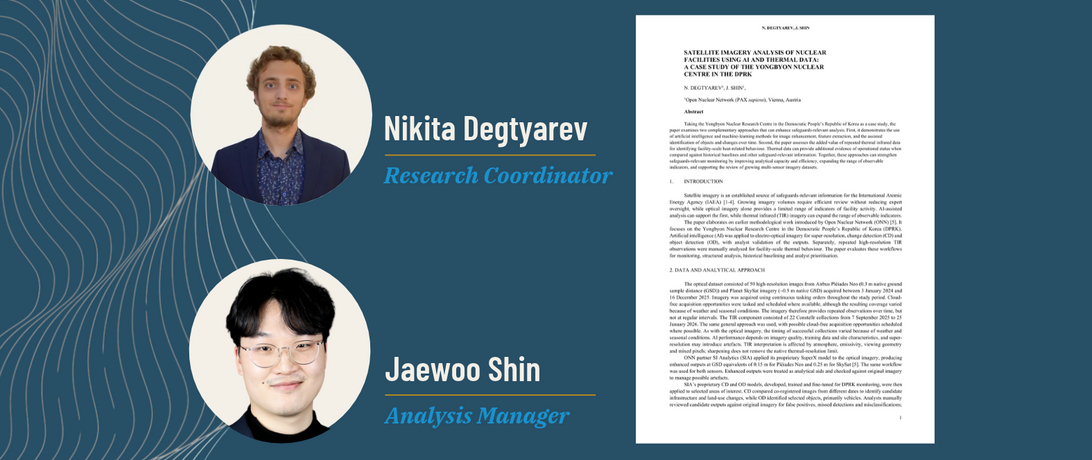
ONN Research Coordinator Nikita Degtyarev and Analysis Manager Jaewoo Shin co-authored a paper presented at the International Atomic Energy Agency's (IAEA) Symposium on International Safeguards 2026 in Vienna.
Using the Yongbyon Nuclear Research Centre in the Democratic People's Republic of Korea (DPRK) as a case study, the paper examines how AI-assisted optical imagery analysis and thermal infrared (TIR) satellite imagery can enhance safeguards-relevant analysis. The research explores how these complementary approaches can support the monitoring of nuclear facilities, identification of activity indicators and assessment of operational status.
Key Findings
- AI-assisted analysis can strengthen imagery screening, task prioritisation and structured monitoring. Super-resolution, change detection and object detection helped analysts identify infrastructure changes, vehicles and other indicators of facility activity. Analyst-validated findings were organised into geospatial datasets, supporting systematic comparisons across locations and dates.
- TIR imagery provides complementary indicators of facility activity. Repeated thermal observations revealed variable temperature contrasts near the cooling-water outflow of Yongbyon's 5 MWe reactor. When interpreted alongside optical imagery and historical information, such observations can provide additional evidence to support assessments of facility operational status.
- Combining complementary approaches could strengthen historical baselines and consistency analysis. AI-assisted optical imagery analysis and TIR observations provide different types of information about nuclear facilities. Together, they could improve the comparison of observations over time and help identify developments requiring further investigation.
- Analyst validation and corroboration remain essential. AI-generated outputs may contain errors or artefacts, while thermal observations are affected by environmental and acquisition conditions. Reliable interpretation therefore requires analyst oversight, traceability to original data and corroboration with other available information.
Abstract
Taking the Yongbyon Nuclear Research Centre in the Democratic People’s Republic of Korea as a case study, the paper examines two complementary approaches that can enhance safeguards-relevant analysis. First, it demonstrates the use of artificial intelligence and machine-learning methods for image enhancement, feature extraction, and the assisted identification of objects and changes over time. Second, the paper assesses the added value of repeated thermal infrared data for identifying facility-scale heat-related behaviour. Thermal data can provide additional evidence of operational status when compared against historical baselines and other safeguard-relevant information. Together, these approaches can strengthen safeguards-relevant monitoring by improving analytical capacity and efficiency, expanding the range of observable indicators, and supporting the review of growing multi-sensor imagery datasets.
Article Details
Published
Written by
Topic
Program
Content Type
Resources