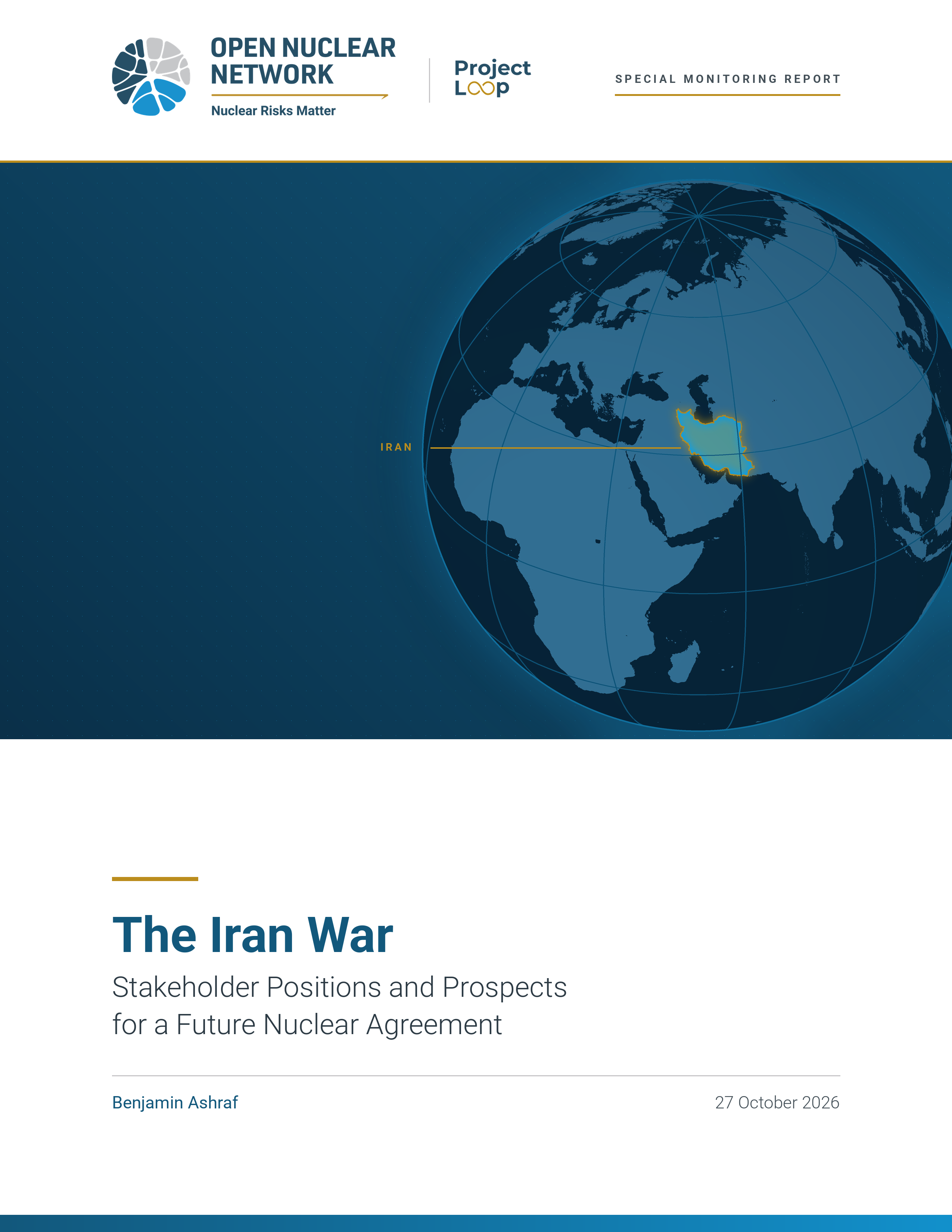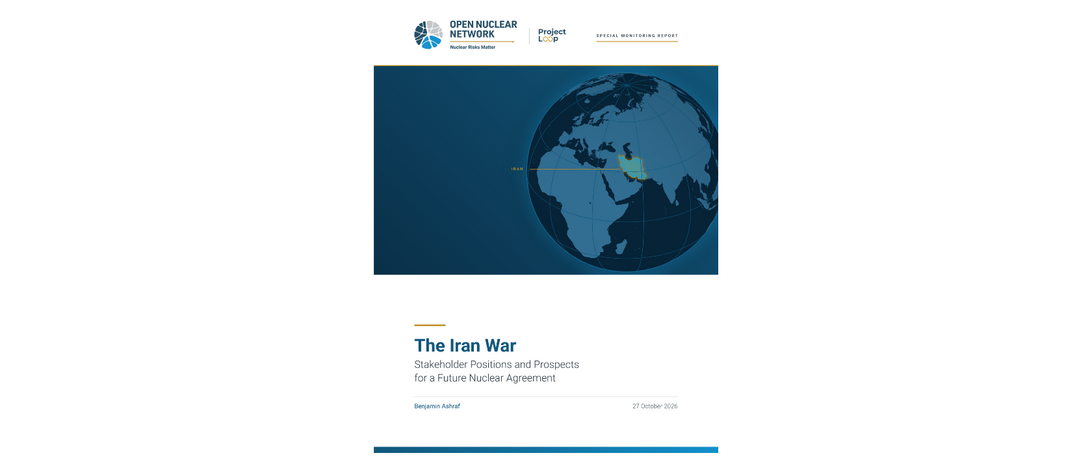
As part of Project Loop, Open Nuclear Network (ONN) has published a new Special Monitoring Report, The Iran War: Stakeholder Positions and Prospects for a Future Nuclear Agreement, authored by ONN Assistant Analyst and Coordinator Benjamin Ashraf. The report examines the positions of key regional and international stakeholders and assesses the prospects for a future nuclear agreement between Iran and the United States.
Following renewed military escalation in the Middle East and the breakdown of diplomatic efforts in 2026, significant disagreements remain over Iran’s nuclear programme, uranium enrichment, sanctions relief and regional security. Against this backdrop, ONN examined the interests, constraints and potential areas of compromise among the United States, Iran, Israel, Gulf states and other diplomatic actors through Project Loop forecasting, continuous monitoring, open-source analysis and expert engagement.
What Does ONN Assess?
ONN assesses, with medium confidence, that a comprehensive agreement similar to the Joint Comprehensive Plan of Action (JCPOA) remains unlikely by the end of 2026. Instead, a more plausible near-term outcome is a limited and potentially fragile arrangement focused on reducing immediate nuclear and maritime risks, restoring some IAEA verification access and easing disruptions to shipping through the Strait of Hormuz.
The report highlights significant differences between stakeholders’ positions, particularly concerning uranium enrichment, sanctions relief and security guarantees. While opportunities for phased diplomatic arrangements remain, the report finds that broader disputes are more likely to be temporarily managed than fully resolved.
From Forecasting to Stakeholder Analysis
The report builds on a Project Loop forecasting question asking whether Iran would agree to restrict uranium enrichment for at least six months by 3 November 2026.
To better understand the prospects for such an agreement, ONN conducted continuous monitoring from May to September 2026, combining open-source research with insights from regional experts and ONN Advisory Council members.
The resulting analysis maps the negotiating positions, priorities and constraints of key stakeholders, including the United States, Iran, Israel, Gulf states, the European Union, Pakistan, Jordan and China, identifying potential areas of convergence and obstacles to a future agreement.
Why This Matters
One of the report’s central findings is that restoring credible nuclear verification remains essential to reducing escalation risks. Continued uncertainty surrounding Iran’s enriched uranium stockpile, nuclear infrastructure and IAEA access complicates efforts to reach a sustainable agreement.
The report also highlights how tensions over the Strait of Hormuz and regional security could trigger renewed military escalation, even if limited diplomatic understandings are reached. Any future agreement will therefore need to address not only nuclear restrictions, but also the broader security concerns influencing the negotiating positions of regional stakeholders.
Through Project Loop, ONN combines forecasting, monitoring, open-source analysis and expert engagement to identify emerging escalatory risks and support informed decision-making aimed at reducing nuclear risks.