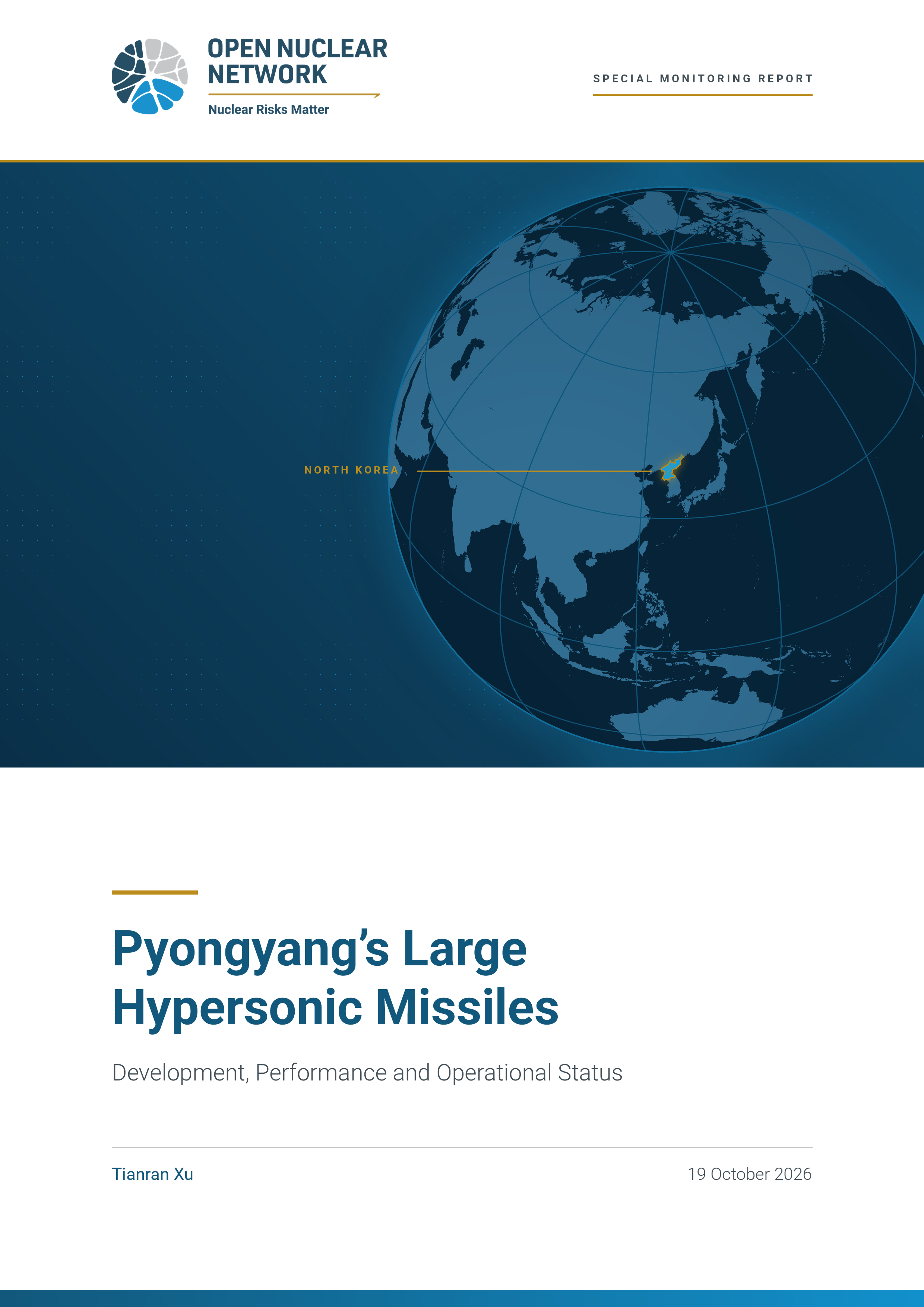
ONN's Special Monitoring Report, "Pyongyang's Large Hypersonic Missiles. Development, Performance and Operational Status", authored by ONN Senior Analyst Tianran Xu, examines North Korea’s two large hypersonic missile systems, the conical-shaped “Hwasong-16Ga” and the wedge-shaped Hwasong-16Na, following the first reported operational launch of the former on 3 October 2026.
Reviewing seven flights since 2021, it compares the development and demonstrated performance of both systems, examines discrepancies between North Korean claims and Japanese and South Korean flight assessments, and considers the implications for regional missile defence and nuclear risk.
Key Findings
- Operational readiness: The Hwasong-16Ga’s first operational firing drill suggests North Korea considers the system ready for deployment, while the operational status of the Hwasong-16Na remains uncertain.
- Missile defence challenges: The manoeuvrability and unpredictable flight paths of North Korean HGVs complicate regional missile defence, although discrepancies in reported flight distances do not necessarily indicate surveillance vulnerabilities.
- Range limitations: Both systems have demonstrated the potential to strike Japan, but their ability to reach intermediate ranges of 3,000–5,500 km remains unverified.
- Regional arms race: The deployment of North Korean HGVs could accelerate missile development and competition on the Korean Peninsula, further complicating regional security dynamics.