The Geography of Nuclear Restraint in a Fragmenting Order

Nuclear-Weapon-Free Zones in an Unstable Security Environment

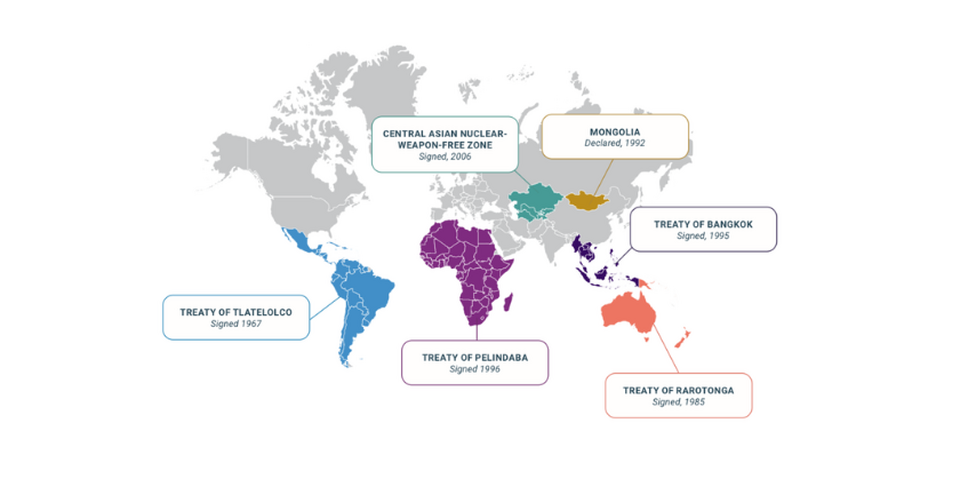
In a more unstable security environment, nuclear-weapon-free zones remain important frameworks for organising regional nuclear restraint. Drawing on consultations across all existing zones, this report examines how they reduce risk, support confidence, and strengthen safeguards and peaceful nuclear governance. It also shows that the regime is under growing strain from unresolved protocol questions, capacity constraints, weak coordination, and structural gaps that leave some states outside the existing model.
Key Findings

  • Nuclear-weapon-free zones are not just legal prohibitions. They function in practice as tools of regional security governance, nuclear risk reduction, and political restraint.
  • Their importance is growing as arms control weakens. NWFZs now stand among the last durable treaty-based frameworks for collective nuclear restraint.
  • The regime is more valuable, but also more uneven, than is often recognised. Existing zones have shown durability and adaptability, but still face unresolved protocol questions, institutional and capacity constraints, and weak coordination.
  • Institutional continuity is a key determinant of effectiveness. Strong zones do not all share the same design, but they do need a durable focal point, regular consultation, institutional memory, and the capacity to respond to new pressures.
  • Negative security assurances matter, but they are only part of the picture. Zones can still provide substantial security value even where protocol adherence is incomplete, which makes sustained dialogue with nuclear-weapon states essential.
  • The regime remains structurally incomplete. Mongolia’s experience shows that the classic regional model does not adequately accommodate strategically exposed states outside existing zonal arrangements.
  • Coordination across zones remains too weak. Existing NWFZs still operate more like parallel arrangements than a coherent system, limiting shared learning and collective responses to common pressures.
  • The report calls for more serious, treaty-specific engagement by nuclear-weapon states, including on protocols, implementation support, and inter-zonal coordination.
Banner for upload