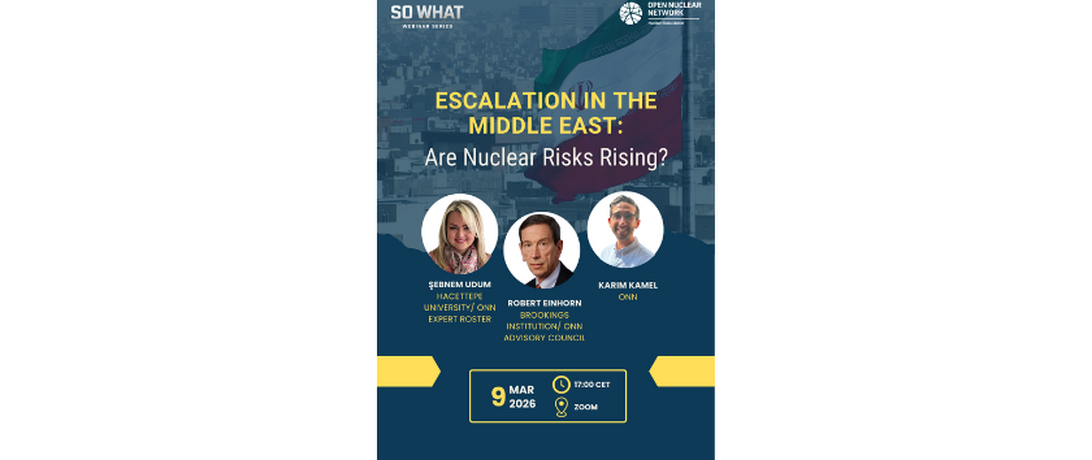
ONN Webinar recap: Escalation in the Middle East – Are Nuclear Risks Rising? Watch our discussion on what recent regional escalation could mean for nuclear risks.
Revisiting ONN's Forecast
The discussion began with Karim Kamel presenting ONN’s earlier forecasting exercise conducted through the organization’s expert roster. In January, ONN experts assessed the probability of US and Israeli strikes on Iran at roughly 40%, based on inputs from 52 experts.
Karim explained that the forecast reflected a mix of signals observed at the time. These included military deployments in the region, political messaging from key actors, and broader geopolitical dynamics that suggested a possible escalation. At the same time, experts also identified several reasons why strikes might not occur, including ongoing negotiations, regional opposition to escalation, and uncertainty about whether military action would achieve its intended strategic effects.
Overall, the forecast closely tracked prediction markets, which had similarly placed the probability of strikes in the 30–40% range at the time of ONN’s workshop.
Which Nuclear Risks Are Rising?
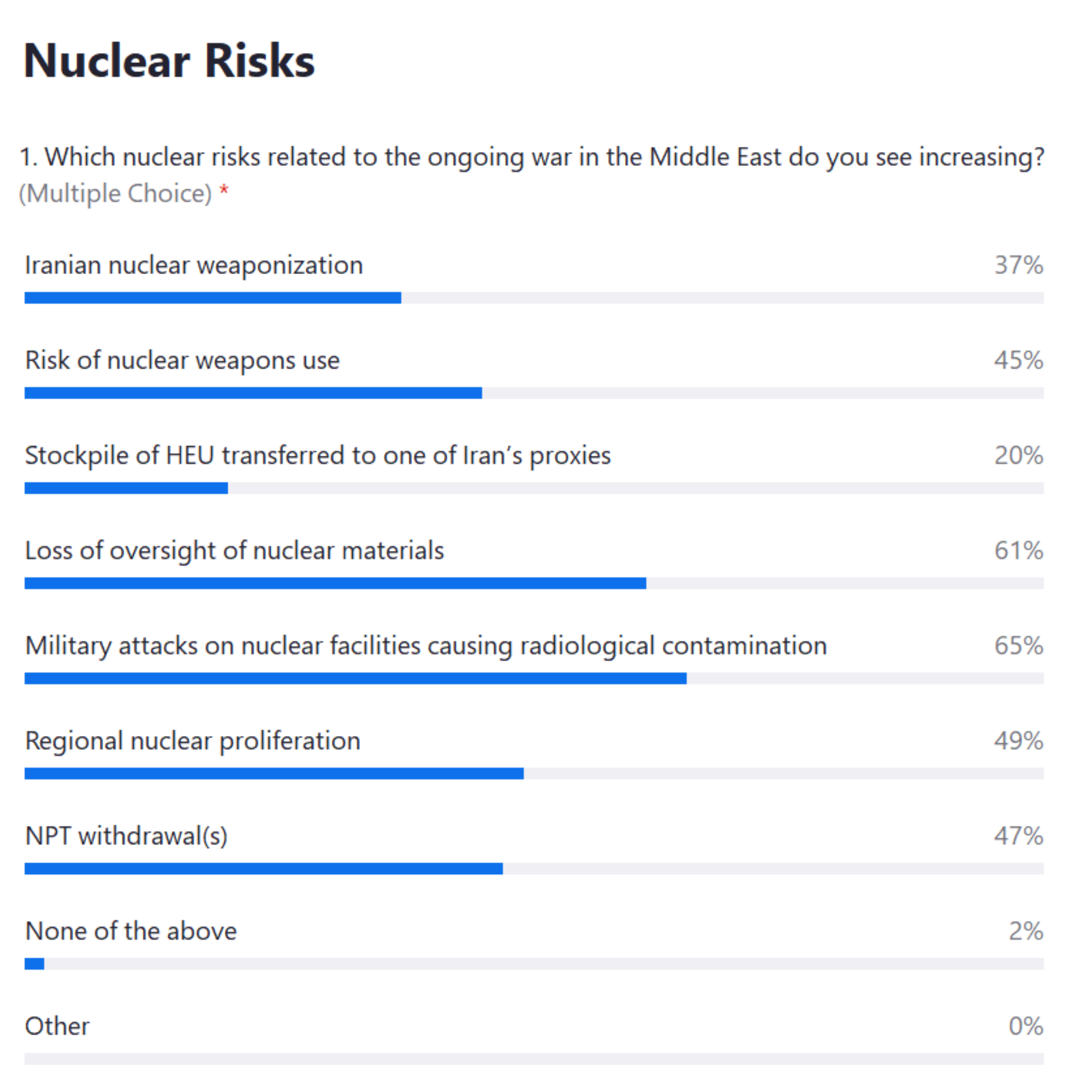
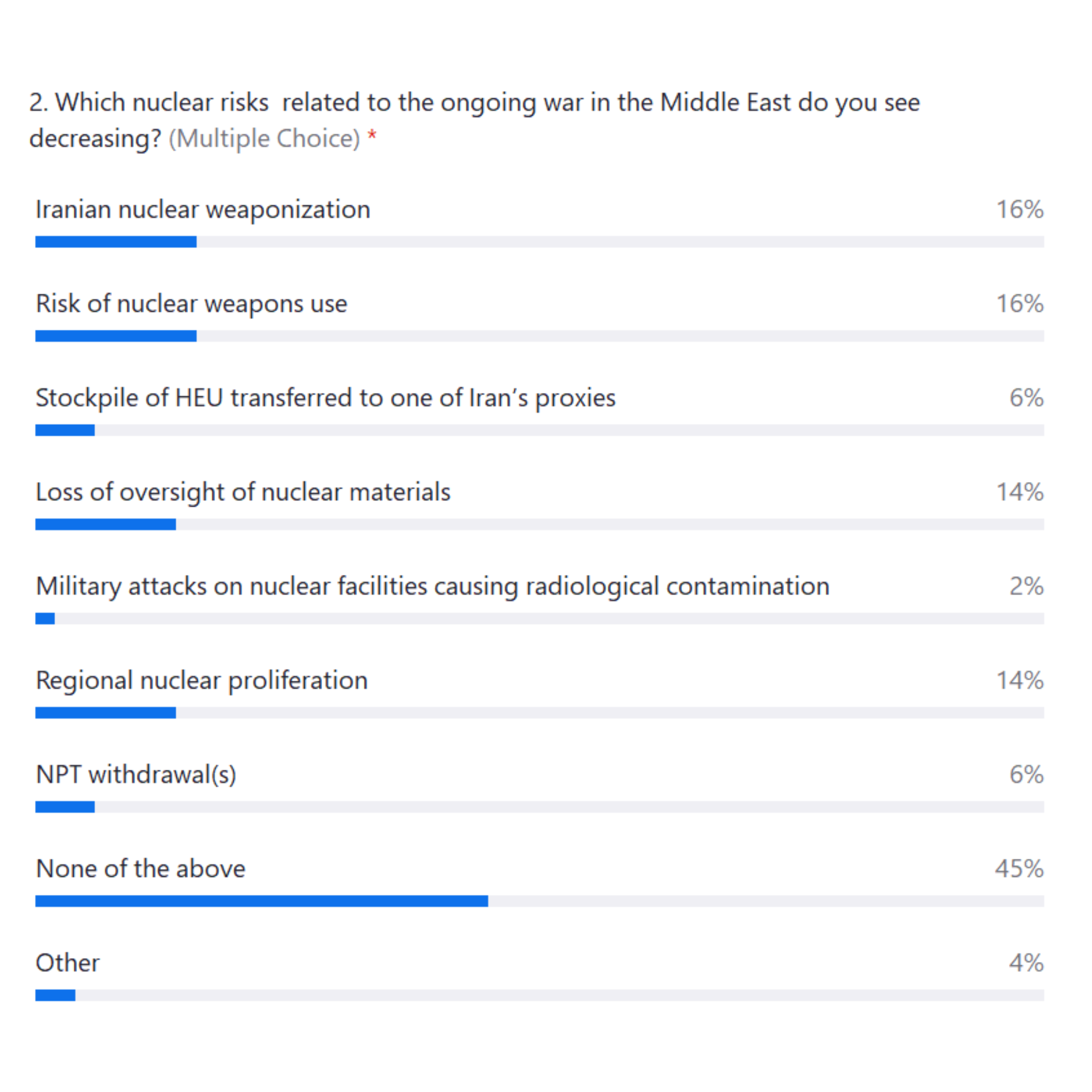
An audience poll conducted during the webinar asked participants which nuclear risks had increased or decreased due to the escalation.
Participants most frequently identified military attacks on nuclear facilities, loss of oversight over nuclear materials, and potential nuclear weaponization as the risks most likely to increase.
Reflecting on these results, Kamel noted that most participants believed none of the nuclear risks had meaningfully decreased, highlighting widespread concern about the implications of the crisis.
Iran’s Nuclear Weaponization Risk
Robert Einhorn focused on what the conflict might mean for the likelihood that Iran eventually builds a nuclear weapon.
He argued that the impact of the current war could move in two directions. On one hand, large-scale military attacks and rhetoric around regime change may reinforce Iranian perceptions of existential threat, potentially strengthening the argument within Iran that only nuclear weapons can provide credible deterrence.
On the other hand, the campaign has also demonstrated the vulnerability of Iran’s nuclear infrastructure and the deep penetration of US and Israeli intelligence capabilities. According to Einhorn, these factors could discourage Iran from pursuing a covert nuclear weapons programe by highlighting how difficult it would be to hide such activities.
At present, he suggested that the conflict may temporarily decrease the risk of a nuclear-armed Iran, though the outcome will ultimately depend on factors such as Iran’s leadership trajectory and how the war ends.
Nuclear Risks Beyond Weaponization
Şebnem Udum emphasised that nuclear risks should not be analysed only in technical terms. Decisions about nuclear weapons, she argued, are fundamentally political, shaped by threat perceptions, national identity, and the strategic role states assign to particular weapons.
From this perspective, Udum warned that the escalation risks increasing nuclear dangers indirectly by raising threat perceptions. When states believe that negotiations can be overtaken by military force, they may become more inclined to pursue stronger deterrent capabilities. This dynamic could weaken the long-standing norm that being a non-nuclear-weapon state under the NPT is a security asset, potentially encouraging more states to reconsider the role of nuclear deterrence.
She also highlighted the broader normative implications of the crisis. International legal norms and institutions were developed over decades to reduce the likelihood of war and encourage diplomacy as the primary means of managing disputes. When conflicts involving nuclear questions move away from diplomatic channels toward military confrontation, Udum suggested, it risks undermining those norms and reinforcing a more coercive security environment.
At the same time, she cautioned that nuclear risk should be understood in multiple dimensions. While direct nuclear weapon use remains highly unlikely, other risks may be more plausible, including loss of control over nuclear materials, attacks on nuclear facilities causing radiological consequences, or escalation dynamics that increase pressure on states to pursue deterrent capabilities.
Iran’s Internal Dynamics
Karim also discussed how the escalation might affect Iran’s internal political dynamics and nuclear trajectory.
For decades, Iran has framed its nuclear programme around the right to peaceful nuclear energy and the right to uranium enrichment, while also maintaining that nuclear weapons are prohibited under a religious decree. However, the current crisis may place pressure on this narrative, particularly if Iranian leaders conclude that nuclear restraint has not enhanced their security.
At the same time, Karim noted that the regime currently appears to be consolidating rather than collapsing, though forecasting outcomes on regime stability may change as events continue to unfold.
Implications for Nuclear Diplomacy
Turning to the future of nuclear diplomacy, the panel agreed that short-term prospects for negotiations appear limited.
Einhorn noted that the United States has expressed skepticism about Iranian intentions in negotiations, while Iranian leaders remain deeply distrustful of US commitments. One of the central points of disagreement remains uranium enrichment: the United States has called for Iran to abandon enrichment entirely, while Iran insists on retaining at least some domestic enrichment capability.
Despite these challenges, Einhorn argued that a compromise allowing Iran to maintain a small, tightly monitored enrichment programme could still reduce proliferation risks and reassure regional actors, even if such a deal currently appears politically difficult for both sides.
Udum similarly stressed that diplomacy remains the most effective pathway for reducing nuclear risk. However, meaningful negotiations require conditions in which both sides see incentives to return to the table and can do so without appearing to concede defeat. In this context, face-saving mechanisms and indirect diplomacy may play an important role.
Possible Scenarios for the Next 6–12 Months
The panelists outlined several plausible scenarios for the coming year.
Karim identified three broad possibilities:
- A Regional spillover, where additional actors become involved in the conflict;
- A unilateral declaration of victory by one side leading to a pause in strikes;
- A negotiated ceasefire or diplomatic arrangement
He also suggested that the crisis may create an opportunity to revisit longer-term regional security arrangements, including ideas such as a Middle East weapons-of-mass-destruction-free zone.
Einhorn outlined a different set of scenarios. The most optimistic would involve regime change and a new Iranian government abandoning nuclear weapons ambitions. A second possibility would see the current regime survive but reach a negotiated deal limiting its nuclear activities. The third scenario, which Einhorn considered the most likely, would involve continued tensions, limited diplomacy, and recurring cycles of confrontation.
Such an outcome, he warned, could create a persistent “cat-and-mouse” dynamic between Iran and its adversaries, increasing long-term proliferation pressures and regional instability.
Questions from the Audience
During the Q&A session, panelists addressed whether the conflict could encourage other states to conclude that only nuclear weapons guarantee security.
Udum noted that this risk highlights why preserving the non-proliferation norm remains essential. If states begin to believe that nuclear weapons are the only reliable deterrent, the entire architecture of nuclear restraint could weaken.
Einhorn added that nuclear security can also be maintained through security alliances and extended deterrence, which have historically helped many states avoid pursuing their own nuclear weapons programs.
The panel also discussed the possibility of Iran withdrawing from the Nuclear Non-Proliferation Treaty (NPT). Kamel noted that ONN forecasting had previously estimated a roughly 15% probability of such a move in the near term. While withdrawal would be provocative, Einhorn suggested it may still be more likely than Iran immediately pursuing nuclear weapons.
Steps to Reduce Nuclear Risk
In closing, the speakers highlighted several practical measures that could help reduce nuclear risk in the near term.
Kamel emphasised the importance of regional mediation and diplomacy, particularly involving countries with strong regional ties such as Oman, Turkey, and Egypt.
Udum underscored the need for face-saving diplomatic pathways and backchannel engagement, which could allow negotiations to resume without forcing either side into politically untenable positions.
Einhorn pointed to a more immediate technical priority: the restoration of IAEA monitoring activities in Iran, including renewed accounting of highly enriched uranium and advanced centrifuges. Reestablishing safeguards, he argued, would significantly reduce uncertainty about Iran’s nuclear activities.
The discussion underscored the central theme of ONN’s “So What?” series: understanding not only what is happening in global crises, but what those developments mean for nuclear risk and what actions might reduce the nuclear risks.