This webinar explored the Franco-German nuclear cooperation. Watch the recording to learn more.
Webinar Summary
Franco-German nuclear cooperation is becoming more concrete. But the discussion at ONN’s latest “So What?” webinar suggested that some of the most common ways of describing it - a French nuclear umbrella, European nuclear sharing, or even an emerging European nuclear deterrent - risk obscuring what Paris and Berlin are actually doing.
The discussion brought together Héloïse Fayet, Research Fellow and Head of the Deterrence and Proliferation Programme at the French Institute of International Relations (IFRI) and ONN Expert Roster Member; Jacob Ross, Research Fellow at the German Council on Foreign Relations (DGAP); and Linus Höller, Assistant Analyst at ONN. The webinar was moderated by Kseniia Pirnavskaia, Network and Engagement Specialist at ONN.
Audience poll: how do people see Franco-German nuclear cooperation?
Before the discussion, participants expressed diverse views on the direction and implications of Franco-German nuclear cooperation. The largest share - 45% - saw it as a step towards a broader European nuclear deterrent, followed by 39% who viewed it as mainly political and strategic dialogue and 34% as growing operational cooperation within existing deterrence arrangements. Smaller shares saw it primarily as an extension of French strategic interests - 26% - or a step towards a French nuclear umbrella for Europe (24%).
Views on its implications for nuclear risk were similarly mixed. Nearly half - 48% - believed closer cooperation could reduce some risks while creating new ones, while 21% felt it was too early to tell.
Equal shares expected it to reduce (12%) or increase (12%) nuclear risks, while just 6% anticipated little overall effect.
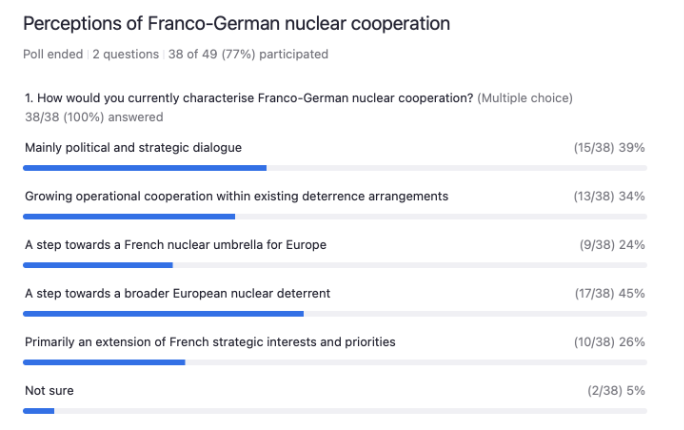
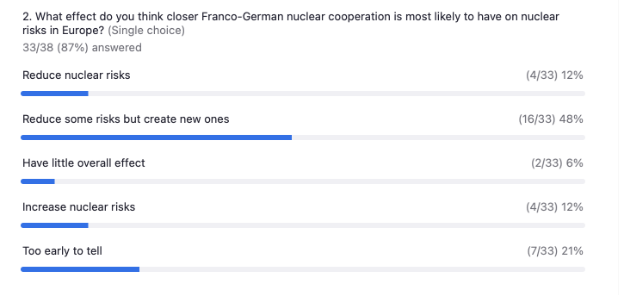
The results set up two questions that ran through the webinar: what exactly are France and Germany building, and does it ultimately reduce or increase nuclear risks?
What stood out from the discussion?
- Think coordination rather than cooperation. The emerging relationship is less about creating a jointly controlled deterrent and more about developing strategic understanding, exercises, crisis communication and greater mutual support between nuclear and conventional deterrence.
- France is not offering a replica of the US nuclear umbrella.
- French nuclear weapons remain under sovereign French control, and France is not seeking German financing for its arsenal.
- “Shouldering” may be an important part of the model. The concept of épaulement points towards France’s nuclear capabilities and Germany’s growing conventional capabilities supporting one another within a broader European deterrence posture.
- Germany’s changing position cannot be understood without Washington. Ross argued that German strategic thinking remains highly dependent on US policy, making developments in Washington a crucial variable in the future of Franco-German coordination.
- Strategic culture may matter as much as military hardware. France and Germany still need to develop a shared vocabulary, understanding of doctrine, threat assessments and approaches to escalation management.
- Political timing matters. Institutionalising the dialogue before future political transitions may determine whether the present momentum becomes durable.
- How others perceive the initiative matters. Russia reacted strongly to Macron’s broader forward deterrence speech, although Fayet had not seen a comparable response to the specific 17 July Franco-German declaration. How Moscow and other actors interpret the emerging operational cooperation therefore remains uncertain.
- The nuclear-risk implications remain contested. The speakers disagreed on whether the initiative ultimately reduces or increases nuclear risk, highlighting the tension between stronger deterrence and new signalling, perception and escalation pathways.
The webinar also built directly on ONN’s work through Project Loop. During a previous forecasting cycle, ONN asked its Expert Roster whether the Franco-German Nuclear Steering Group would produce a communiqué or equivalent output containing at least one operationally specific deliverable by the end of September 2026.
The Roster assigned the scenario a 53% probability. The question subsequently resolved YES following developments in July, providing the starting point for the webinar’s examination of what had changed and where the relationship might be heading next.
From dialogue to operational signals
Opening the substantive discussion, Linus Höller explained that ONN’s forecasting question had been deliberately designed to distinguish political dialogue from something more tangible. The existence of Franco-German discussions was already well established. The more interesting question was whether those conversations would begin producing visible and operationally relevant outcomes. Developments in July provided some of the first indications that this threshold was being crossed.
Höller pointed to an aerial refuelling exercise involving a French tanker, a German Eurofighter and a French Rafale, as well as the visit of a French strategic Rafale to a German airbase. He characterised these activities as still predominantly symbolic but noted that they nevertheless carried an operational dimension.
German participation in a French nuclear exercise also emerged as an important development. Germany’s involvement would remain conventional. Höller nevertheless stressed that the degree of access itself is notable given how closely France traditionally guards its nuclear deterrent.
There was, however, an important qualification regarding exactly which exercise Germany might join. Höller discussed participation in France’s Poker exercise, while Fayet cautioned that Germany’s first involvement could instead take place through a smaller and less visible French nuclear exercise. The precise operational form of the cooperation therefore remains something to watch.
Höller also drew attention to changing German public opinion. Polling discussed during the webinar suggested that support for Franco-German nuclear cooperation - or at least discussions in that direction - has increased substantially, moving from around half of respondents to more than 70% in some recent polls.
For Höller, the fact that tangible developments continued even during the European summer period was itself noteworthy, suggesting a degree of urgency and political importance behind the initiative.
What it is not: a French nuclear umbrella for Europe
One of the clearest interventions during the webinar came when Fayet responded directly to the audience poll. The largest share of participants had characterised Franco-German cooperation as a step towards a broader European nuclear deterrent. Fayet argued that this did not accurately reflect the French view.
France’s emerging forward deterrence approach remains fundamentally a French initiative. The French nuclear deterrent remains under sovereign French control, and the objective is not to reproduce the US extended deterrence model or establish a European version of NATO nuclear sharing. Instead, France is seeking to incorporate allied vital interests more closely into its own strategic calculations while retaining sovereign control over its arsenal and nuclear decision-making.
Fayet was equally explicit about another misconception:
The relationship should therefore not be understood as a transaction in which Germany helps finance France’s arsenal in exchange for protection. Instead, Fayet described a broader effort to create a more coherent European defence and deterrence posture. Germany is investing heavily in conventional deterrence, land forces and long-range strike capabilities. France contributes a sovereign nuclear deterrent. Other countries bring different capabilities. The objective is not for all participants to do the same thing, but to make those different elements work more coherently together.
Épaulement or “Shouldering”: linking nuclear and conventional deterrence
One concept that emerged repeatedly in the discussion was the French idea of épaulement, described during the webinar as “shouldering” or mutual support.
Rather than Germany gaining some control over French nuclear weapons, the idea points towards greater coordination between the capabilities that France and Germany already possess. Ross argued that this may be one of the most interesting elements of the emerging arrangement from a German perspective. France retains its sovereign and modernising nuclear deterrent, while Germany is investing heavily in conventional capabilities, including long-range strike. The question is how these different strengths can be connected within a more coherent European deterrence posture.
Fayet placed épaulement within a wider process of developing common strategic understanding. This could include more regular dialogue on threat perceptions and doctrine, crisis communication, scenario-based discussions and exercises on escalation management.
In this sense, épaulement or “shouldering” is not simply about combining military capabilities. It is about improving how states understand and support one another across the conventional and nuclear dimensions of deterrence.
What could this coordination look like in practice?
Fayet offered a useful comparison for how this relationship might evolve. Rather than resembling NATO nuclear sharing, she suggested that some aspects could look more like the way the United States works with South Korea and Japan: strategic dialogue, efforts to build a common strategic culture, scenario planning and discussion of escalation, without permanently stationing French nuclear weapons in Germany.
She was clear that permanent peacetime deployment of French nuclear weapons in Germany is not the objective. At the same time, she left open the possibility that a temporary deployment might theoretically be considered during a crisis. The distinction helps clarify the emerging model. It is primarily about coordination, shared understanding and mutual support rather than replicating an existing nuclear-sharing arrangement.
Building a common strategic culture - and a common strategic language
If Franco-German coordination is not primarily about sharing weapons or nuclear decision-making authority, a major part of the work lies elsewhere: building a common strategic culture and learning to speak the same strategic language.
Fayet pointed to more regular exchanges on threat assessments, improved understanding of each other’s doctrines, crisis communication, scenario planning, tabletop exercises and escalation management. France and Germany do not necessarily assess every strategic problem in the same way - including the nature of the Russian threat - making such dialogue important in its own right.
But this cannot happen overnight. As Fayet cautioned: “It takes a lot of time to build trust between two countries.”
That trust also needs to develop between administrations with different strategic cultures and ways of working. High-level political meetings can initiate the process, but Fayet argued that dialogue eventually needs to move further down into ministries and bureaucracies, including desk officers and mid-level officials. In such a sensitive field, some of this work may actually benefit from taking place behind closed doors, where officials can ask difficult questions and become familiar with each other’s thinking without immediate political or media pressure.
Ross highlighted why this matters. France and Germany do not always mean the same thing when they use the language of deterrence. He pointed to recurring misunderstandings in German discussions about French nuclear doctrine. The assumption that France wants Germany to help finance its arsenal is one example. Another is the French concept of strategic ambiguity, which some German audiences can interpret as an unwillingness to share information because France does not sufficiently trust its partners. Ross argued that this misunderstands the role strategic ambiguity plays within French deterrence thinking.
Closer coordination therefore requires more than military exercises. Officials, analysts and eventually wider political communities need to become familiar with each other’s vocabulary, doctrines and assumptions.
For Ross, even the fact that France and Germany have begun discussing a domain traditionally regarded as central to French sovereignty is itself significant:
Germany’s nuclear debate has a third participant: Washington
One of the strongest themes from the German perspective was that Franco-German nuclear coordination cannot really be understood as a two-country story. Washington remains a critical third variable.
Ross argued that Germany’s willingness to pursue closer strategic coordination with France is still heavily shaped by US policy. In his assessment, German strategic culture remains highly dependent on decisions taken in Washington, particularly when it comes to nuclear deterrence and wider European security.
He stressed that the current momentum did not originate solely from an internal German strategic debate. Rather, it has been driven in large part by external pressure: war in Ukraine, uncertainty surrounding the future of US extended deterrence, and concerns that Washington may become less willing to carry the same security burden in Europe.
This helps explain why earlier French offers received little response from Berlin. President Macron had previously invited European partners, including Germany, to engage more closely on the role of the French deterrent. But as long as confidence in the traditional transatlantic security architecture remained high, there was limited pressure within Germany to explore alternatives.
Ross cautioned that the current direction is therefore not necessarily irreversible. If a future US administration were to strongly reaffirm the traditional American security role in Europe, parts of the German political establishment could become less interested in developing alternative European arrangements and return to a more familiar transatlantic model.
He linked this to previous fluctuations in Franco-German defence cooperation. In his reading, pressure for deeper European cooperation increased following Donald Trump’s first election, diminished again after Joe Biden entered office, and has intensified as uncertainty about US policy returned.
This creates a structural question for Paris and Berlin: how can they build a durable European strategic relationship if Germany’s willingness to deepen that relationship continues to depend heavily on political developments in Washington?
Fayet offered a somewhat different assessment. She argued that even a future US administration strongly recommitted to European security would not necessarily restore the previous status quo. In her view, trust in the durability of US guarantees has already been damaged, particularly among countries on NATO’s eastern flank. European deterrence initiatives may therefore retain a rationale beyond any individual US administration.
The discussion exposed an important tension: Berlin is seeking greater European strategic capacity partly because of uncertainty about Washington, while its willingness to pursue that autonomy remains itself strongly influenced by what Washington does next.
Can the initiative survive political change?
The discussion repeatedly returned to another source of uncertainty: elections.
France’s 2027 presidential election is particularly significant because nuclear policy in France is closely connected to presidential authority, and much of the current momentum is associated with President Emmanuel Macron’s approach to European defence. Ross argued that a political transition could therefore affect not only policy but also the networks of trust that currently sustain Franco-German cooperation. New political actors could enter office without the same institutional relationships or established channels between Paris and Berlin.
Fayet was somewhat more optimistic. She argued that even a government with very different political priorities might not dismantle an initiative that had already become established. The priority should therefore be to institutionalise as much as possible before political transitions occur. Regular meetings, exercises and bureaucratic relationships should become routine rather than remaining dependent on individual leaders.
Public opinion could become part of the problem
The political challenge is not limited to elections. Fayet highlighted the public reaction in France following the July Franco-German announcements, noting strong criticism of Germany in parts of French political and social media debate. She contrasted this with much more limited public attention surrounding French nuclear steering groups with countries such as Poland or Sweden. In her view, the intensity of reactions to Germany revealed a deeper level of distrust that could eventually constrain how far coordination can develop.
Ross also warned against bringing highly sensitive nuclear discussions into public political competition too early. High-level and expert dialogue can gradually build common understanding, but premature politicisation could encourage actors to use nuclear deterrence primarily as a vehicle for domestic political positioning rather than engaging with its strategic and technical complexities.
This concern returned at the end of the webinar, when Ross described politicisation as one of the risks he would watch most closely as nuclear deterrence becomes a more prominent subject in Germany and across Europe.
How might Russia - and others - perceive it?
The discussion also underlined that Franco-German intentions are only one part of the equation. How the initiative is interpreted outside Europe is equally important for its effect on nuclear risk.
On Russia specifically, Fayet cautioned against drawing conclusions too early. At the time of the webinar, she had not seen a strong Russian response to the 17 July Franco-German declaration itself. This contrasted with Moscow’s reaction to President Macron’s broader forward deterrence speech in March 2026, which Fayet described as much stronger. Russia characterised the proposals as destabilising and compared them to nuclear sharing. Fayet stressed that, from the French perspective, this comparison is inaccurate: France is not proposing the permanent deployment of French nuclear weapons abroad.
For now, therefore, how Moscow will interpret and respond specifically to the emerging Franco-German operational coordination remains unclear.
Ross suggested that the developments would nevertheless be watched in Russia, China and elsewhere. From a German perspective, he argued, they may signal that Berlin is becoming more willing to consider alternatives to longstanding strategic dependence on the United States and to develop a greater capacity for independent European strategic thinking.
Höller introduced a more cautionary perspective. Even if European policymakers make careful distinctions between nuclear sharing, French sovereign control and strategic coordination, other governments may not interpret those distinctions in the same way. The initiative could instead be presented politically as evidence that European nuclear arrangements are expanding - and potentially be invoked to justify nuclear developments elsewhere. He pointed to Russia’s nuclear relationship with Belarus, which Moscow has partly framed in relation to existing NATO nuclear sharing. Further European coordination could therefore be portrayed as another change to the nuclear balance, regardless of whether France and Germany regard such a comparison as technically or politically valid.
This leaves an important question open: will Russia ultimately treat Franco-German coordination as a meaningful change in Europe’s nuclear posture, or regard the current steps as primarily political and symbolic?
For now, the answer remains uncertain. More broadly, the exchange highlighted a central nuclear-risk challenge: what an initiative is intended to signal and what another state believes it signals may be very different things.
Could European coordination reduce proliferation pressures?
The discussion also examined whether closer coordination around the French deterrent could address another emerging question: calls for European countries to acquire nuclear weapons of their own. Ross noted that arguments for an independent German nuclear deterrent remain marginal, but they already exist within German political debate and could become more prominent if current security and political trends continue. A credible European process involving France could, in his assessment, offer an alternative to such national approaches. Fayet agreed with the logic, although she stressed that preventing national proliferation was not the primary purpose of the initiative. She nevertheless described it as a potentially positive side effect.
Höller’s intervention added an important complication: even if closer European coordination reduces proliferation incentives inside Europe, it might be interpreted very differently outside Europe. Political narratives elsewhere may reduce a complicated arrangement to a much simpler message: Europe is expanding nuclear coordination, and therefore others can do the same.
Transparency, secrecy and the NPT
Questions from the audience also brought the discussion beyond Europe to the implications for arms control and the wider non-proliferation regime. How transparent should Franco-German nuclear coordination be, particularly when many non-nuclear-weapon states continue to call for greater transparency and accountability from nuclear-weapon states?
Fayet acknowledged the tension. Some secrecy is inherent to credible nuclear deterrence and is necessary for sensitive strategic dialogue to function. At the same time, sufficient transparency is needed to explain what is - and importantly, what is not - being developed. She argued that France and its partners need to find the right balance between protecting sensitive information and reassuring others about the scope of the initiative, including making clear that it does not constitute nuclear sharing or permanent deployment of French nuclear weapons abroad.
The same communication is relevant to deterrence itself: some information must remain protected, while strategic signalling needs to provide an adversary with sufficient understanding of intentions and capabilities.
Does Franco-German coordination ultimately reduce nuclear risk?
The webinar concluded by returning to the audience poll. Nearly half of respondents - 48% - had selected perhaps the most ambivalent answer: Franco-German nuclear cooperation would reduce some risks but create new ones.
The speakers themselves did not reach a common verdict.
Linus Höller: potentially more variables, more risk
Höller leaned towards the view that the initiative could increase overall nuclear risk, although he stressed that this concern did not necessarily mean the initiative itself was the wrong policy response. He acknowledged the stabilising logic: stronger European deterrence could potentially reduce the likelihood of Russian or Belarusian nuclear use during a confrontation by strengthening the expected consequences. His concern was the additional complexity introduced into the nuclear relationship.
More actors, expectations and potential escalation pathways could create new possibilities for miscalculation, particularly if actions that previously would not have been expected to trigger a nuclear response begin to be interpreted differently under a changing deterrence architecture.
Héloïse Fayet: stronger deterrence can lower the risk of use
Fayet reached the opposite conclusion. She argued that a more coherent European deterrence posture - combining nuclear deterrence with stronger conventional capabilities - should ultimately reduce nuclear risk by making deterrence more credible across a wider range of possible attacks.
She also argued that increased dialogue among European countries about French and British nuclear doctrine could itself contribute to risk reduction. Better understanding of the limited scenarios in which nuclear use might actually be contemplated could clarify that many security challenges should first be addressed through dialogue and conventional capabilities.
Fayet acknowledged that closer coordination could create risks of misunderstanding, but suggested these could be mitigated through better explanations, transparency and engagement by countries participating in the forward deterrence initiative.
Jacob Ross: lower proliferation risk, but watch politicisation
Ross also leaned towards the view that risks could decrease. His reasoning focused particularly on Germany: a credible European dialogue around nuclear deterrence could reduce the likelihood that a future German debate turns towards acquiring a national nuclear arsenal. But he identified a different danger. As nuclear deterrence becomes more European and more publicly discussed, it could also become increasingly politicised. Political actors with little interest in the strategic or technical dimensions of deterrence could use the issue for wider domestic political purposes.
So what?
The webinar did not produce a simple verdict on whether Franco-German nuclear coordination is stabilising or destabilising - and that may be one of its most useful conclusions. The initiative is developing because European governments already perceive serious risks: the war in Ukraine, Russian nuclear signalling and uncertainty surrounding the future of US extended deterrence. Closer coordination could address some of those vulnerabilities. It could strengthen European deterrence, improve strategic dialogue, better connect conventional and nuclear thinking and reduce pressure for new national nuclear arsenals.
At the same time, those same developments could generate new risks.
More complex deterrence relationships can create additional opportunities for misunderstanding. Russia and other states may interpret European intentions differently from how Paris or Berlin intend them. Greater public attention could politicise nuclear policy. And changes in political leadership - in Paris, Berlin or Washington - could alter the assumptions and relationships on which the emerging system depends. The discussion therefore suggested that the key question is not simply whether Franco-German nuclear cooperation is “good” or “bad” for nuclear risk.
The more useful questions are: what form will it take, how far will épaulement between nuclear and conventional capabilities develop, how will it be communicated, how will other states interpret it, and can the political and institutional relationships needed to manage it become durable?
As moderator noted in closing, this remains a rapidly evolving process. Further operational steps, exercises, political changes and reactions from other states will therefore need to be monitored closely to understand where Franco-German nuclear coordination ultimately leads.