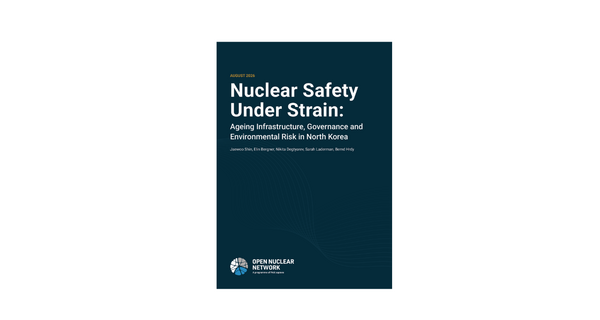
This webinar marked the launch of the latest ONN report and explored the safety and environmental challenges associated with the DPRK’s expanding and ageing nuclear infrastructure.
Audience Poll: What Are People’s Concerns Regarding DPRK Nuclear Risks?
Before the presentation, participants were asked which risks associated with North Korea’s nuclear programme concerned them most and which nuclear safety and environmental vulnerabilities they considered most significant.
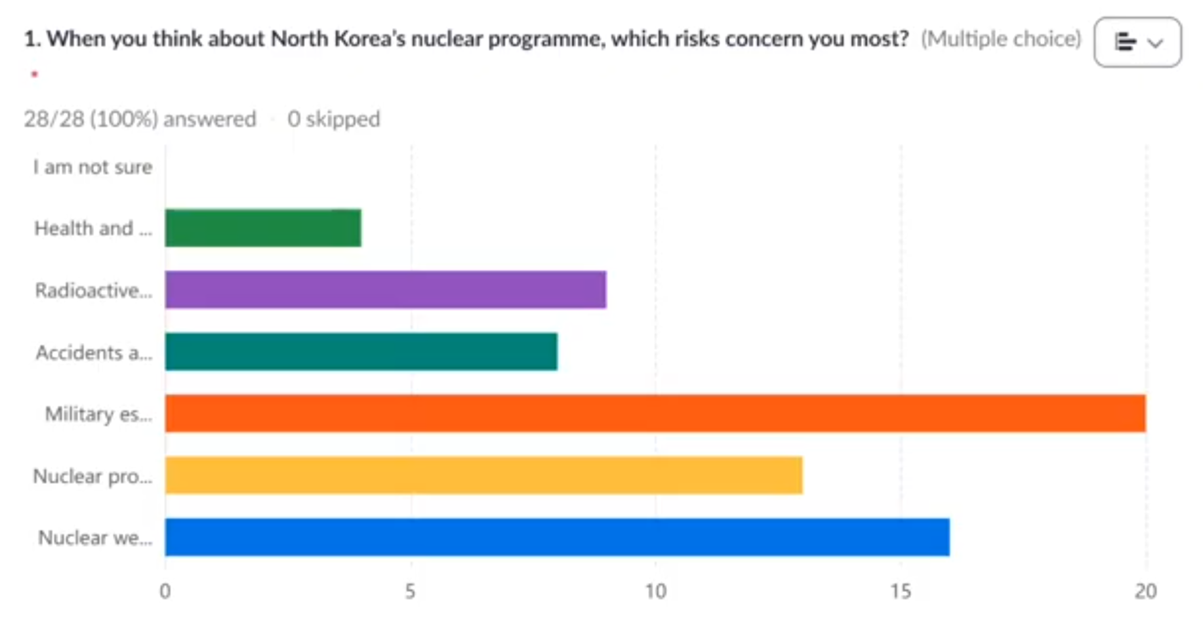
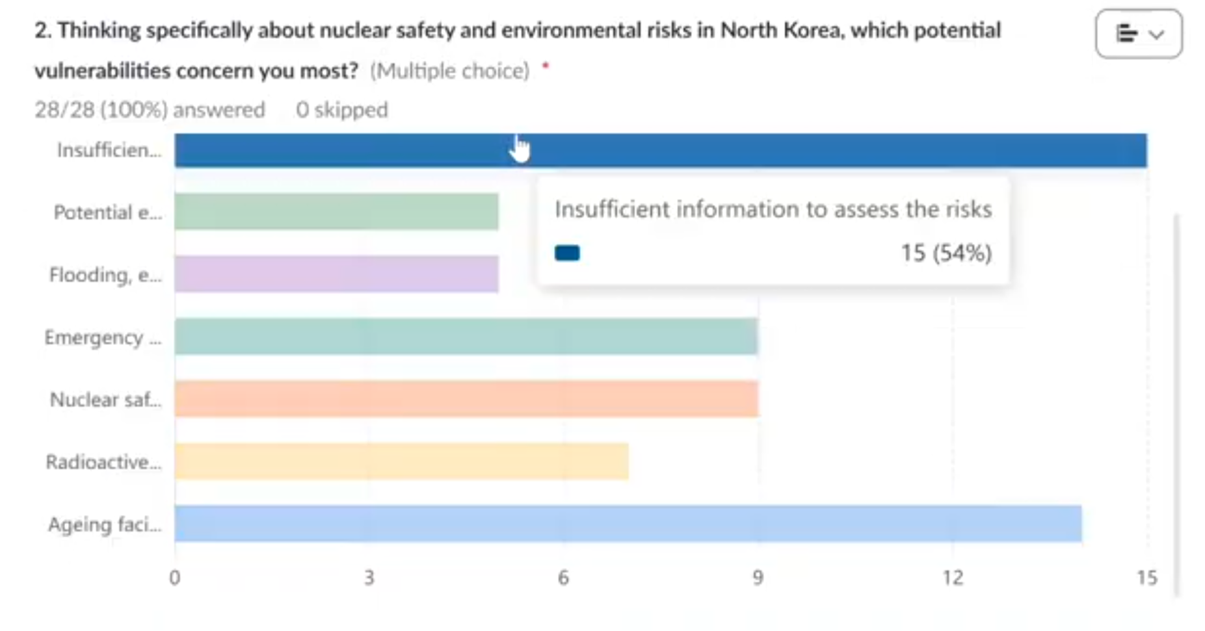
Military escalation or miscalculation emerged as the leading overall concern, followed by nuclear weapons use. When participants were asked specifically about nuclear safety and environmental risks, insufficient information to assess the risks ranked first, followed by ageing facility infrastructure.
The results highlighted one of the central challenges explored throughout the webinar: significant uncertainties remain about current conditions inside North Korea’s nuclear facilities, even as the programme continues to expand and infrastructure ages. The discussion therefore turned to two practical questions: what can we still learn about these risks despite the information gaps, and what can be done now to better monitor, understand and prepare for them?
What technical vulnerabilities exist?
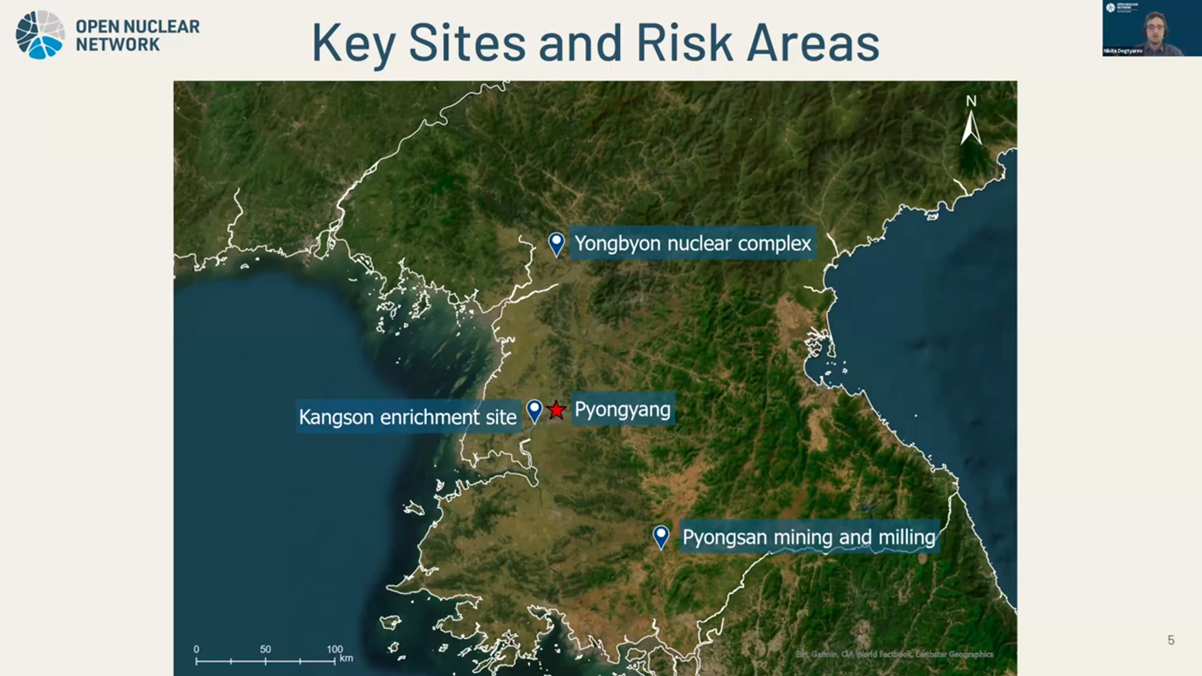
Nikita Degtyarev examined credible failure mechanisms across North Korea’s nuclear fuel cycle, from uranium mining and milling to conversion and enrichment, reactor operations, spent fuel, reprocessing and radioactive waste. At Pyongsan, uranium milling produces large volumes of tailings and process water, creating potential risks from leakage, spillage, dust and chemical exposure. Conversion and enrichment activities introduce different hazards, as a loss of uranium hexafluoride containment could produce highly corrosive hydrogen fluoride as well as uranium-bearing compounds. At Yongbyon, the ageing 5 MWe reactor and the newer Experimental Light Water Reactor (ELWR) present distinct safety questions, while both depend on water-control infrastructure that has repeatedly experienced hydrological stress. Spent fuel and radioactive waste create additional longer-term concerns, including corrosion, contaminated pond water and sludge, and the potential for localised leakage from storage and waste systems.
Overall, the assessment highlighted a combination of ageing infrastructure, chemical hazards, gradual degradation and long-term spent fuel and waste management challenges. Severe accidents remain technically possible, but limited information about current facility conditions and safety systems makes their likelihood difficult to assess reliably.
How could a release become environmental exposure?
A central part of the research examined how radioactive or chemical material might move through the environment and who or what could be exposed.
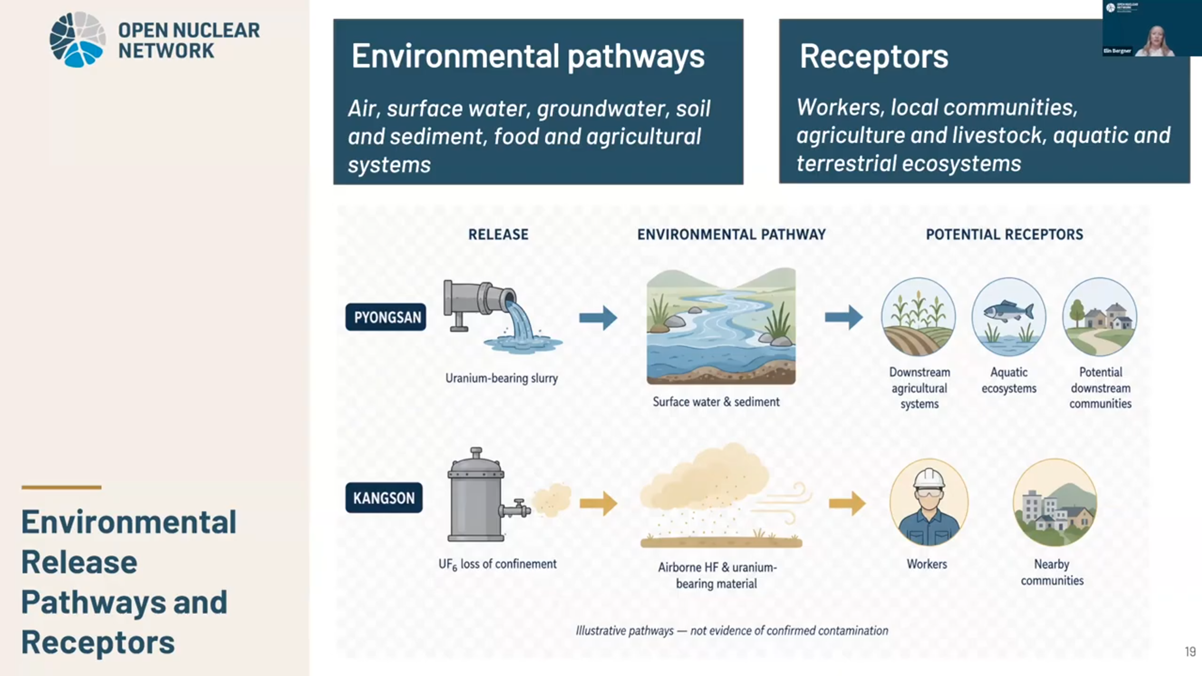
Elin Bergner introduced potential environmental pathways through air, surface water, groundwater, soil and sediment, as well as agricultural systems. At Pyongsan, for example, leakage from uranium-processing infrastructure could affect nearby soil and potentially enter connected river systems. At Yongbyon, gradual leakage from spent fuel or waste systems could first affect nearby buildings, soil and groundwater, while a severe accident could create a broader atmospheric pathway. At Kangson, a loss of uranium hexafluoride confinement could create an immediate inhalation hazard and deposit uranium-bearing material on surrounding soil.
Importantly, these pathways represent technically plausible routes, not evidence that contamination or exposure has occurred. Actual consequences would depend on factors including the quantity and form of material released, geology, hydrology, weather and how surrounding land and water are used.
Looking Ahead
The webinar underscored that nuclear safety should not be treated as separate from wider efforts to understand and reduce nuclear risk on the Korean Peninsula. Ageing infrastructure, radioactive waste, environmental hazards and uncertainty about current safety practices may develop gradually, but their consequences could be long-lasting.
These risks also have implications beyond accident prevention. If international inspectors or technical experts are ever able to return to North Korean nuclear facilities, whether through verification or renewed technical cooperation, the physical condition of those facilities and the location and management of hazardous material will directly affect what can safely be done on the ground.
The report therefore calls attention to risks that are difficult to observe but should not be overlooked. Sustained monitoring, preservation of technical knowledge and advance preparation can help ensure that governments and international organisations are better equipped to respond to future incidents or opportunities for engagement.