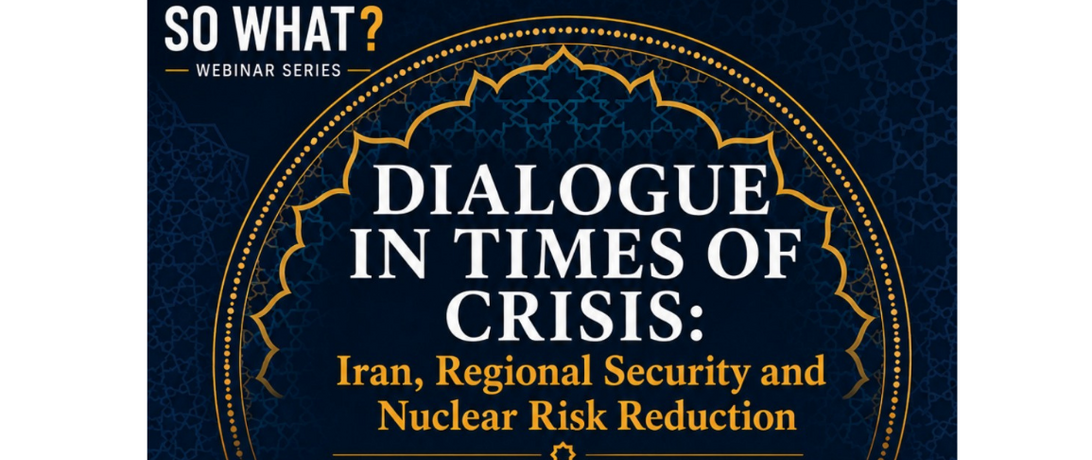
Webinar Recap - Dialogue in Times of Crisis: Iran, Regional Security and Nuclear Risk Reduction

This webinar explored dialogue during crisis, regional security challenges and nuclear risk reduction, while marking the launch of Student/Young Pugwash Iran. Watch the full recording to learn more.

Webinar Summary 

On 16 June 2026, Open Nuclear Network (ONN) participated in and supported a discussion convened in partnership with International Student/Young Pugwash, the Nations' Diplomacy Think Tank, the Center for Graduate International Studies of the University of Tehran, and Student/Young Pugwash Iran. The discussion explored the importance of dialogue during periods of crisis, with particular attention to the conflict in the Middle East, regional security dynamics and opportunities for risk reduction. The event contributed to ONN’s “So What?” webinar series and focused on the importance of dialogue in times of crisis.

The webinar also marked the launch of Student/Young Pugwash Iran, a new national chapter of the International Student/Young Pugwash (ISYP) network. Inspired by the mission of the Pugwash Conferences on Science and World Affairs, which promotes the use of scientific knowledge and dialogue to address global security challenges and reduce the risks posed by weapons of mass destruction, Student/Young Pugwash brings together students and early-career professionals interested in peace, security, science diplomacy, and nuclear risk reduction. Through research, dialogue, training and international collaboration, the initiative aims to support the next generation of leaders working to address complex global challenges. 

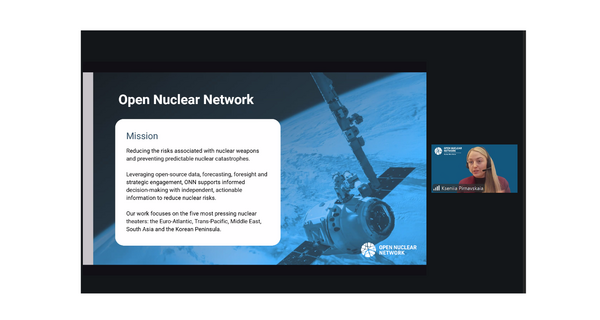
Moderated by Kseniia Pirnavskaia, ONN Network and Engagement Specialist and Deputy Director of International Student/Young Pugwash, the discussion brought together Dr Hussein Al-Shahristani, President of the Pugwash Conferences on Science and World Affairs and Former Minister of Higher Education and Scientific Research of Iraq; Dr Karen Hallberg, Secretary General of the Pugwash Conferences on Science and World Affairs; Dr Ali Akbar Salehi, Former Foreign Minister of Iran and Former Head of the Atomic Energy Organization of Iran; Dr Ariabarzan Mohammadi, Assistant Professor at the University of Tehran; Dr Hamed Vafaei, Professor of China Studies and Former Director General, Office of International Relations at the University of Tehran; and Sayed Mohammad Ali Sayedhanaee, Founder and President of Nations Diplomacy Think Tank.  


Dialogue in Times of Crisis – The Pugwash tradition 

The discussion opened with a reflection on the importance of dialogue at a moment of heightened regional tension. Dr Hussein Al-Shahristani welcomed the establishment of Student/Young Pugwash Iran and situated the discussion within the broader mission of the Pugwash movement. He recalled that Pugwash was founded by scientists who believed that scientific knowledge carries not only great power, but also profound responsibility. He emphasised that nuclear science has contributed significantly to medicine, agriculture, industry, environmental protection and energy production. At the same time, nuclear technology also gave rise to the most destructive weapons ever created. The central challenge, he argued, is ensuring that scientific progress remains directed toward peaceful and beneficial purposes.

Dr Al-Shahristani also linked the discussion to the long-standing goal of establishing a Weapons of Mass Destruction-Free Zone in the Middle East. He recalled that Iran and Egypt jointly introduced a UN resolution on such a zone in 1974 and stressed that although progress has been slow, the vision remains essential for regional peace and security.

Dr Karen Hallberg also welcomed the launch of Student/Young Pugwash Iran and underlined the importance of involving young professionals in global security discussions. She highlighted Pugwash’s work across four main areas: nuclear weapons, regional security, chemical and biological weapons, and science and security. She emphasised the role of scientific reasoning, intellectual honesty and open-minded dialogue in addressing complex international problems. Dr Hallberg also stressed that Pugwash can support new generations by providing networks, scientific knowledge and spaces for dialogue across national and disciplinary boundaries.


Diplomacy and the Lessons of the Joint Comprehensive Plan of Action (JCPOA) 

Drawing on his experience as Iran’s former Foreign Minister and former Head of the Atomic Energy Organization of Iran, Dr Ali Akbar Salehi argued that dialogue is not a luxury or an academic abstraction, but a strategic necessity. 

Reflecting on the Joint Comprehensive Plan of Action, Dr Salehi noted that while views on the agreement differ, it demonstrated that diplomacy remains the most rational, least costly and most sustainable means of resolving international disputes. He stressed that even deeply rooted conflicts can be addressed through sustained dialogue, mutual respect and political courage. Salehi also highlighted the importance of protecting scientific and academic institutions during conflict. Universities, he argued, are not military assets but centres of learning, discovery and innovation. If science and education are to contribute to peace, they must be protected rather than becoming casualties of conflict. 

During the Q&A, Salehi addressed questions on a possible future agreement between Iran and the US, uranium enrichment, Europe’s role in future diplomacy and Iran’s fatwa against weapons of mass destruction. He reiterated that Iran would not give up rights it views as protected under the NPT, while remaining committed not to pursue nuclear weapons. 


Regional Security After the Crisis 

Dr Ariabarzan Mohammadi examined how recent developments may affect Iran’s relations with Arab countries and other regional actors. He argued that recent conflicts have challenged long-standing assumptions about nuclear deterrence, noting that nuclear capabilities have not prevented attacks or escalation in several contemporary conflicts. Dr Mohammadi suggested that the political, ethical and material costs of nuclear use remain powerful constraints. He also argued that institutions such as Pugwash contribute to shaping norms against nuclear use and to promoting dialogue on peaceful nuclear cooperation. 

Looking ahead, he called for a new approach between Iran and Arab countries, based on direct dialogue, interdependence and recognition of shared geography, history and culture. He suggested that regional actors have increasingly recognised that external security guarantees cannot replace direct engagement among neighbours. 


Iran–China Relations in a Changing Regional Landscape 

The webinar also included a video intervention by Dr Hamed Vafaei, Professor of China Studies and former Director General of the Office of International Relations at the University of Tehran. His remarks provided context on Iran’s relationship with China, China’s role in the region and Iran’s place within an evolving eastern geopolitical landscape. Reflecting on the implications of the recent conflict, Dr Vafaei argued that the region is entering a new geopolitical phase that is unlikely to resemble the pre-war status quo. He suggested that the responses of regional states, external powers and Iran itself point towards the emergence of a new regional order in West Asia.

Dr Vafaei noted that while China has traditionally engaged West Asia primarily through economic cooperation, recent developments have highlighted a more visible diplomatic and security role. He argued that China's growing engagement could create new opportunities for cooperation between Iran, China and regional actors. In this context, he suggested that Iran–China relations may be evolving beyond a predominantly economic partnership towards a broader strategic relationship linked to regional stability. His contribution broadened the discussion beyond the immediate crisis, highlighting how shifting global alignments and regional partnerships may shape Iran’s foreign policy choices and future diplomatic options.


Launching Student/Young Pugwash Iran 

Sayed Mohammad Ali Sayedhanaee discussed the role that the next generation of Iranian experts and dialogue practitioners can play in strengthening regional and global security. He argued that sustainable peace is not built only through formal agreements between governments, but also through trust, communication and long-term human relationships. When official channels are limited or politically constrained, academic institutions, think tanks, scientific communities, civil society organisations and young professionals can help preserve channels of communication and mutual understanding. 

Sayedhanaee described Student/Young Pugwash Iran as a platform to connect Iranian students and young professionals with broader international discussions on peace, security, science diplomacy, nuclear risk reduction and international cooperation. He noted that the initiative aims to organise webinars, policy dialogues, study groups, training workshops and other activities. 

The webinar highlighted both the challenges and opportunities facing regional security at a time of heightened tensions. By bringing young professionals together with policymakers, scholars and scientists, the discussion reaffirmed the value of dialogue as a tool for managing crises, building understanding and advancing nuclear risk reduction.

Webinar: Dialogue in Times of Crisis: Iran, Regional Security and Nuclear Risk Reduction

Watch Webinar: Dialogue in Times of Crisis: Iran, Regional Security and Nuclear Risk Reduction on YouTube.