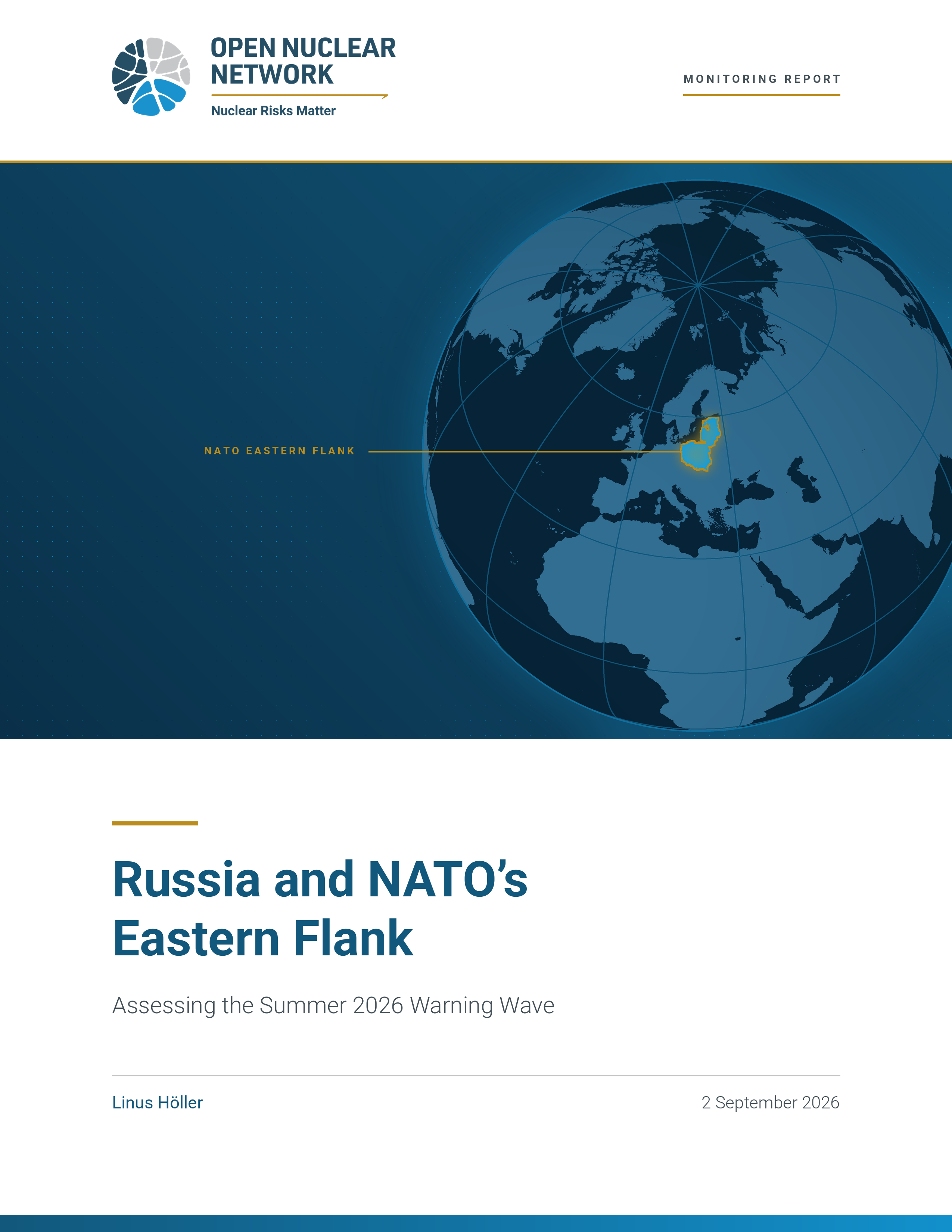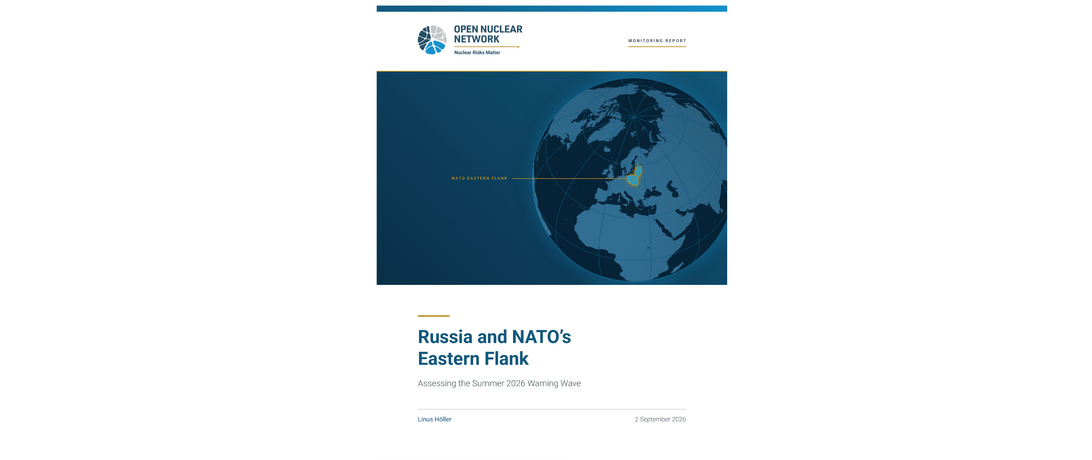
As part of Project Loop, Open Nuclear Network (ONN) is pleased to publish its first Special Monitoring Report, “Russia and NATO’s Eastern Flank: Assessing the Summer 2026 Warning Wave”, authored by ONN Assistant Analyst Linus Höller, examining recent Western warnings of potential Russian provocations against NATO territory.
Since June 2026, officials in Poland, the Baltic States and other NATO countries have publicly warned that Russia could be preparing a limited military or hybrid provocation against NATO’s eastern flank. Given the potential for such an incident to escalate tensions in the Euro-Atlantic region and increase nuclear risks, ONN investigated these warnings through a combination of Project Loop forecasting, open-source analysis and field engagement in Warsaw.
What Does ONN Assess?
ONN assesses that the risk of Russian grey-zone activity against NATO’s eastern flank remains elevated. However, publicly available evidence does not indicate an imminent large-scale Russian attack against a NATO member. Instead, the current threat environment appears to reflect a gradual increase in hybrid confrontation since the beginning of the war in Ukraine. This assessment was reached with moderate confidence.
The most credible near-term risk identified in the report is a limited and deniable operation, such as a drone or missile incident, sabotage, electronic interference or, less likely, a staged border event, designed to create uncertainty and test decision-making while remaining below the threshold of a collective NATO response.
From Forecasting to Field Research
The report builds on a public Project Loop forecasting exercise asking whether Russia would carry out a kinetic attack or clear military provocation against NATO territory before 31 August 2026. Forecasters assessed the scenario as unlikely, with many pointing to Russia’s continued focus on Ukraine and the significant risks associated with directly confronting NATO.
To better understand what was driving the public warnings, ONN subsequently conducted a special monitoring mission to Warsaw in late July, speaking with journalists, policy analysts and other informed contacts. These perspectives were assessed alongside open-source reporting and the Project Loop forecast to develop a more comprehensive picture of the evolving threat environment.
Why This Matters
One of the report’s central findings is the importance of distinguishing between the probability of an incident occurring and the probability of confidently attributing it. In a grey-zone environment, ambiguous drone or missile incidents, sabotage and information operations can create uncertainty that complicates decision-making and increases the potential for miscalculation.
The report concludes that the immediate challenge is therefore not evidence of an imminent large-scale attack, but an elevated and persistent hybrid-threat environment in which even a limited or ambiguous incident could create significant political and military pressure on NATO’s eastern flank.
Through Project Loop, ONN combines forecasting, monitoring, open-source analysis and expert engagement to identify emerging developments that could increase nuclear risks and support better-informed decision-making before crises escalate.