
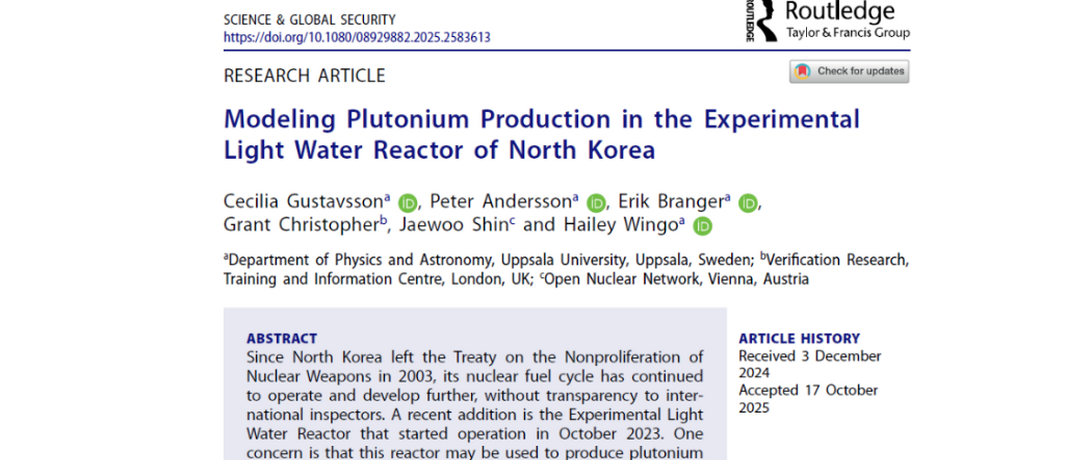
Open Nuclear Network’s Jaewoo Shin co-authored Modeling Plutonium Production in the Experimental Light Water Reactor of North Korea. The recently published article in Princeton University’s Science & Global Security Journal integrates reactor core modelling with satellite imagery monitoring to evaluate how the Experimental Light Water Reactor (ELWR) at Yongbyon could contribute to fissile material production of the Democratic People’s Republic of Korea’s (DPRK), namely plutonium production. By combining reactor core modelling with satellite imagery, it outlines plausible operation modes and observable indicators. Depending on initial enrichment and speed of core reloading, the ELWR could produce up to 20 kg of WG Pu annually. While this would require very rapid core exchanges, modeling based on observed multi-week outages suggests a more realistic annual production rate of up to 15 kg.
While uncertainties remain regarding the reactor’s true power level, fuel design and refueling strategy, the report shows how observable patterns – such as cycle length, outage frequency and other signatures – can help narrow assessments of the reactor’s role within the DPRK’s evolving nuclear fuel cycle. The report also highlights the value of integrating technical modelling with open-source monitoring to improve understanding of the DPRK’s evolving nuclear capabilities. By clarifying the conditions under which the ELWR could be used for weapons-grade plutonium production, the study highlights the DPRK’s nuclear trajectory and key indicators that can support monitoring by the international community.
ABSTRACT
Since North Korea left the Treaty on the Nonproliferation of Nuclear Weapons in 2003, its nuclear fuel cycle has continued to operate and develop further, without transparency to inter- national inspectors. A recent addition is the Experimental Light Water Reactor that started operation in October 2023. One concern is that this reactor may be used to produce plutonium for nuclear warheads, in addition to or instead of being used for electricity production. In this work, fissile material production in the new reactor is explored by modeling a possible core design and integrating information from available remote monitoring, such as satellite imagery of cooling water outlets from the facility. The results indicate that running the reactor with an initial enrichment of 1.75% or lower could potentially produce up to 20 kg of weapons-grade plutonium annually, substantially increasing North Korean plutonium production.